
Evidence Bank Review
July 29, 2026 2026-07-30 0:06Evidence Bank Review
Stage 1 · Early study · All units
Build your assignment on evidence that actually maps to your ACs
You've been collecting workplace examples lesson by lesson. Before you write a word of your assignment, let a practitioner confirm each one earns marks against the criteria — and show you exactly where the gaps are.
We review your evidence. We never supply it.
Every example in your Evidence Bank comes from your own experience — that’s what makes it markable. Our job is to tell you which examples are strong, which ACs they serve, and what’s still missing. We never hand you examples to use, because evidence that isn’t yours can’t survive an assessor’s questions.
How it Works
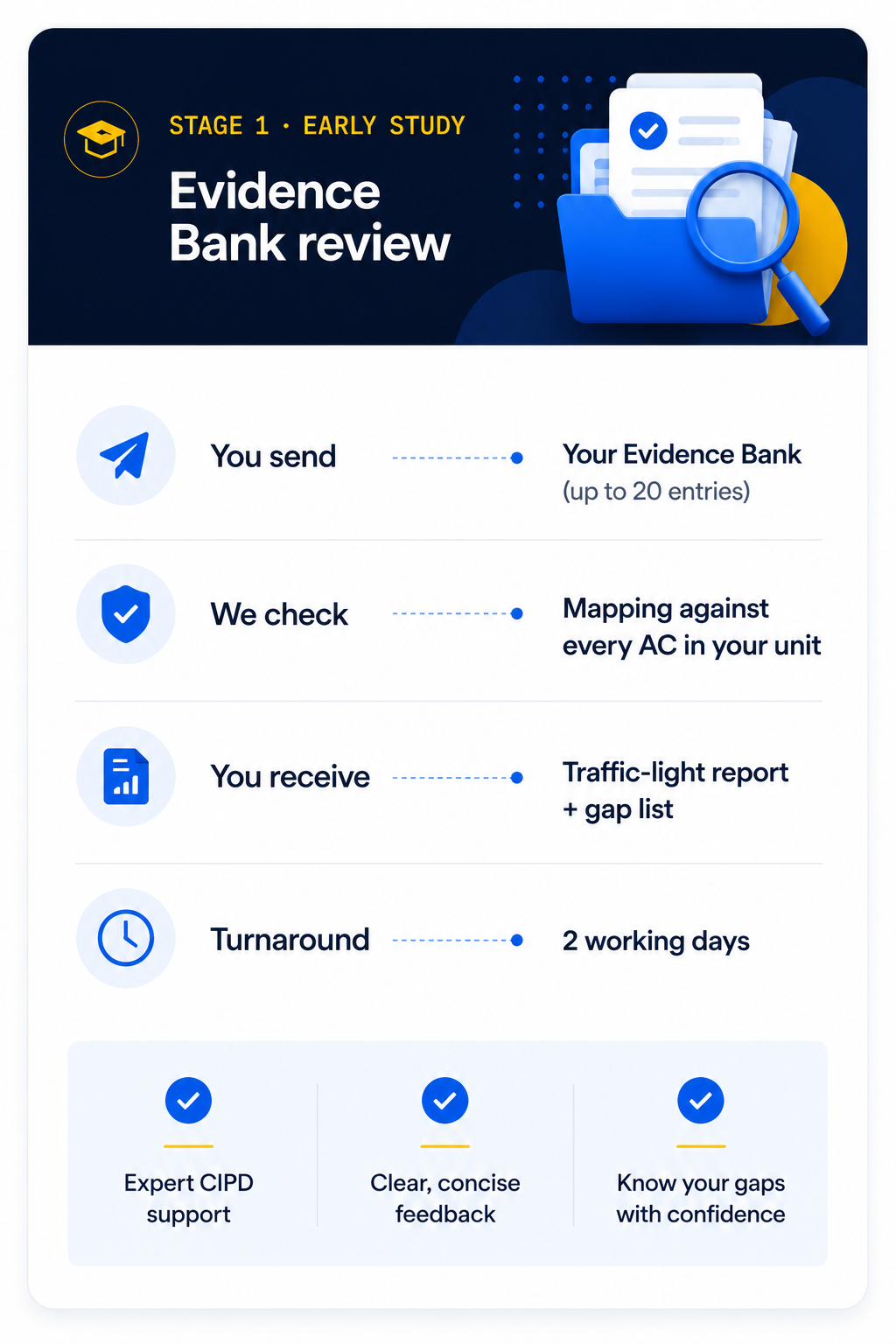
Four steps, two working days
01
Send your Evidence Bank
Upload your entries in any format — the course template, a spreadsheet, or rough notes.
02
We Map Every Entry
A practitioner tags each example against the ACs of your unit’s current brief.
03
Get Your Report
A traffic-light rating per entry: strong, needs development, or won’t earn marks — and why.
04
Fill the Gaps Early
A prioritised list of the ACs still uncovered, with prompts for the kind of experience to look for.
What You Get
A Clear Picture of Your Evidence Before it Costs you Marks
Every entry matched to the criteria it can serve — including double-duty examples you may not have spotted.
Which examples are assignment-ready, which need more detail, and which won’t survive scrutiny.
The ACs you can’t yet evidence, and the kinds of workplace situations that would fill them.
Whether each strong example has enough Situation, Task, Action, Result and Learning to write up.
Your Journey
Where this fits — and what comes next
Stage 1 · Early study
Evidence Bank review
Check your examples map to your ACs before you build on them.
Stage 2 · After drafting
Mock marking
Your draft marked against the real criteria, as comments only.
Stage 3 · Reflection
One-to-one Guidance
45 minutes on whatever is stuck, evenings and Saturdays.
Stage 4 · If needed
Refer Rescue
Assessor feedback translated into a prioritised revision plan.
Two days from now, you'll know exactly where you stand
Book your Evidence Bank review and start your assignment knowing every example has a job to do.
Common Questions
Before you Book
Do I need to have finished the course first?
No — this works best partway through study, once you’ve banked a dozen or more entries. Reviewing early means you can collect what’s missing while you still have time, rather than discovering gaps the week of your deadline.
Will you give me examples to use?
No. Evidence must come from your own experience — supplied examples are both a malpractice risk and easy for assessors to unpick. What we give you is a precise description of what’s missing, so you can recognise it in your own working life.
What if I'm not doing the course with you?
The review is open to everyone. Course owners get priority booking and their Evidence Bank is already in our template, which speeds things up — but any learner on any provider’s programme can book.
Which units do you cover?
All units we publish courses or guidance for, across Levels 3, 5 and 7. When you book, you’ll select your unit and cohort so the review runs against the correct current brief.