
Benchmarking Practices for Evaluating Workforce Effectiveness
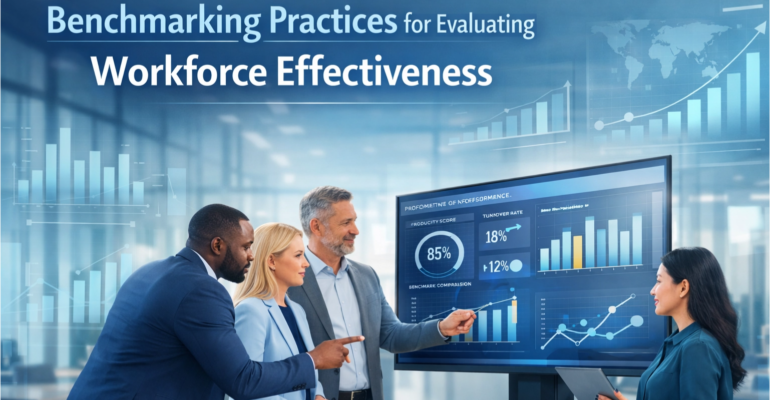

In the contemporary business landscape, the adage “what gets measured gets managed” has never been more relevant. However, as organizations navigate an era of rapid digital transformation and shifting labor dynamics, the focus has evolved from simple management to strategic optimization. Evaluating workforce effectiveness is no longer just an HR exercise; it is a fundamental business imperative. To achieve this, organizations must look beyond their own walls and internal historical data, leveraging benchmarking practices to understand where they stand relative to peers, competitors, and best-in-class performers.
Workforce effectiveness is a multifaceted concept that encompasses how well an organization’s human capital contributes to its strategic goals. It is distinct from workforce efficiency, which often focuses narrowly on cost and output speed. Effectiveness asks: Are we doing the right things with the right people at the right time? Benchmarking provides the yardstick for this inquiry, offering a systematic process for comparing an organization’s work processes and performance metrics to industry best practices.
Defining the Pillars of Workforce Effectiveness
Before diving into benchmarking practices, it is essential to establish a clear framework for what constitutes workforce effectiveness. It is generally understood through three primary pillars:
- Productivity: This is the most traditional measure, focusing on the volume of output relative to the input of labor hours or headcount. However, modern productivity benchmarking also considers the value of that output.
- Quality and Impact: Effectiveness is not just about quantity. It involves the accuracy, innovation, and customer satisfaction generated by the workforce. A highly “productive” team that produces low-quality work is not effective.
- Strategic Alignment: This pillar measures how well employee activities and skills align with the organization’s long-term objectives. A workforce can be busy and high-quality, but if they are working on the wrong priorities, the organization will fail to meet its goals.
The Benchmarking Landscape: Choosing Your Approach
Benchmarking is not a one-size-fits-all activity. Depending on the organization’s maturity and goals, different types of benchmarking may be employed:
Internal Benchmarking
This involves comparing different departments, teams, or geographical locations within the same organization. It is often the easiest place to start because data is readily available and definitions are consistent. Internal benchmarking helps identify “bright spots”—high-performing teams whose practices can be replicated across the company.
Competitive Benchmarking
This is the most common form, where an organization compares its metrics against direct competitors. This provides a reality check on labor costs, turnover rates, and talent attraction capabilities. While direct competitor data can be hard to find, industry associations and specialized consulting firms often provide anonymized datasets.
Functional and Generic Benchmarking
Functional benchmarking looks at similar processes (like recruitment or payroll) in organizations that are not necessarily competitors but are known for excellence in those areas. Generic benchmarking goes even further, looking at world-class performance in any industry. For instance, a hospital might benchmark its patient check-in process against a luxury hotel’s check-in experience.
Strategic Benchmarking
Strategic benchmarking focuses on long-term trends and the fundamental business models of high performers. It asks how the most successful companies are structuring their workforces for the future, such as their adoption of remote work, AI integration, or agile team structures.
Core Metrics for Evaluating Effectiveness
To benchmark effectively, organizations must select the right Key Performance Indicators (KPIs). While there are hundreds of potential HR metrics, a focus on effectiveness requires a curated list of strategic indicators.
| Metric Category | Key Performance Indicator (KPI) | Why It Matters for Effectiveness |
| Financial Impact | Revenue per FTE | Measures the direct economic value generated by each full-time equivalent. |
| Financial Impact | Labor Cost to Revenue Ratio | Indicates the sustainability of the workforce model relative to income. |
| Talent Health | High-Performer Turnover Rate | Distinguishes between “healthy” turnover and the loss of critical talent. |
| Talent Health | Internal Mobility Rate | Reflects the organization’s ability to develop and deploy talent from within. |
| Engagement | Employee Net Promoter Score (eNPS) | Provides a pulse on workforce morale and likelihood to recommend the employer. |
| Process Efficiency | Time-to-Productivity | Measures how quickly a new hire becomes a fully contributing member. |
Revenue and Profit per FTE
These are the “north star” metrics for workforce effectiveness. Revenue per FTE (Full-Time Equivalent) provides a high-level view of productivity. However, Profit per FTE is often more telling, as it accounts for the costs associated with generating that revenue. Benchmarking these against industry peers can reveal whether an organization is over-staffed or if its workforce is significantly more (or less) productive than the competition.
Quality-of-Hire and Time-to-Productivity
A workforce is only effective if its new additions are high-quality. Benchmarking “Quality-of-Hire”—often measured through first-year performance ratings or retention—allows organizations to see if their recruitment strategies are yielding effective long-term contributors. Similarly, “Time-to-Productivity” measures the efficiency of onboarding and training programs.
The Cost of Disengagement: Absenteeism and eNPS
Workforce effectiveness is heavily influenced by employee engagement. High absenteeism rates are often a leading indicator of burnout or low morale, both of which decimate effectiveness. Benchmarking eNPS (Employee Net Promoter Score) against industry averages helps organizations understand if their culture is a competitive advantage or a liability.
Best Practices for Benchmarking Workforce Effectiveness
To derive meaningful insights from benchmarking, organizations should follow a disciplined approach:
1. Contextualize the Data
Raw numbers without context are dangerous. For example, a software company might have a much higher revenue per employee than a retail chain, but that doesn’t mean the retail chain is “ineffective.” When benchmarking, it is crucial to compare like-for-like: organizations of similar size, in the same industry, and with similar business models.
2. Normalize for FTE vs. Headcount
One of the most common mistakes in workforce benchmarking is failing to normalize data. Using “headcount” (the total number of people) can be misleading if an organization has many part-time or contract workers. Always use Full-Time Equivalent (FTE) calculations to ensure a “true” comparison of labor effort.
3. Look Beyond the “Average”
Industry averages are a good starting point, but they represent the middle of the pack. To drive true effectiveness, organizations should aim for “top quartile” or “best-in-class” benchmarks. Benchmarking against the average only ensures that you are as mediocre as everyone else.
4. Ensure Data Integrity and Consistency
Before comparing data, ensure that the definitions are identical. Does “turnover” include retirees? Does “labor cost” include benefits and taxes, or just base salary? Standardizing definitions—often using frameworks like those provided by SHRM (Society for Human Resource Management) or ISO 30414 (Human Capital Reporting)—is essential for accuracy.
5. Move from Descriptive to Prescriptive
Benchmarking should not just describe what is happening; it should suggest why and what to do. If your turnover is 10% higher than the industry average, the benchmark is the trigger for a deeper dive. Is it a compensation issue? A management problem? A lack of career development? The benchmark identifies the gap; the analysis closes it.
Common Pitfalls in Benchmarking
Despite its benefits, benchmarking can lead organizations astray if not handled carefully:
- Benchmark Myopia: Focusing on a single metric (like reducing cost-per-hire) at the expense of others (like quality-of-hire). This can lead to “effective” metrics that actually damage the business in the long run.
- The “Copy-Paste” Fallacy: Assuming that because a practice works for a benchmarked leader (like Google or Netflix), it will work for your organization. Practices must be culturally and operationally compatible.
- Data Lag: Benchmarking data is often retrospective. In a fast-moving economy, last year’s industry average might already be obsolete.
The Future of Workforce Benchmarking: AI and Real-Time Analytics
The future of benchmarking lies in moving away from annual reports toward real-time, AI-driven insights. Modern platforms can now aggregate anonymized data from thousands of companies in real-time, allowing leaders to see how market shifts—such as a sudden spike in demand for AI skills—are affecting talent costs and availability instantly.
Furthermore, predictive benchmarking is emerging. Instead of just looking at where you stand today, AI can help predict where your effectiveness metrics will be in six months based on current trends and external market conditions. This allows for proactive adjustments rather than reactive firefighting.
Conclusion
Benchmarking is the bridge between internal data and external reality. For organizations striving to maximize workforce effectiveness, it provides the necessary perspective to identify strengths, uncover hidden weaknesses, and prioritize strategic investments. By selecting the right metrics, choosing appropriate peer groups, and maintaining a focus on continuous improvement, leaders can transform benchmarking from a static reporting task into a dynamic engine for organizational excellence.
In the end, the goal of benchmarking is not to be exactly like the competition, but to understand the standard of excellence well enough to surpass it. In the quest for workforce effectiveness, the most successful organizations use benchmarks as a floor, not a ceiling.